Beyond The Straits
The enduring narrative of Penang’s merchant aristocracy unfolds at the volatile intersection of colonial ambition and indigenous resilience. From the unyielding grid of Georgetown to the fluid autonomy of the historic Clan Jetties, the island has forged a sanctuary that juxtaposes global trade, cultural synthesis, and architectural permanence in the Strait of Malacca.
The Enduring Narrative of Penang’s Merchant Aristocracy
As the world gets busier and more modern, our tendency to rush around frantically and wear out our brains requires a deliberate withdrawal from the 21st century. While it is not possible to physically time-travel into the 90s (not as of now), it is possible to recreate an experience akin to the 90s in the quaint, post-colonial island of Penang, within its post-colonial capital, George Town.
Radiating a quiet, ancestral authority, the waved terracotta of the Cheah Kongsi stands as a sentinel over Lebuh Armenian.
As someone who has visited the post-colonial municipality twice, walking through George Town is to enter another dialogue with time—a conversation that modern cities have forgotten how to have. Here, the ‘straits eclectic’ architecture isn’t just a choice, it’s a defensive posture. It is a narrative of an aristocracy that didn’t just inhibit a landscape, but commanded it. Between the humid silence of the Hokkein timber-frame architecture of the Kongsis (clan houses) and the timber-weathered residential boardwalks of clan jetties lies a testament to a life lived by choice, not by compromise.
The historical weight of the Peranakan’s first legacies is no more palpable than in one of its clan houses, Seh Tek Tong Cheah Khongsi. Situated amidst the Straits Eclectic and Sino-Portuguese architecture of Lebuh Armenian (Armenian Street), one of the most-visited streets in George Town, The Seh Tek Tong truly stands out as one of the earliest Cheah clan establishments in Penang. Dating back to 1810, it upholds the diverse, yet historic Penangite amalgamation of British Colonial and Hokkien architectures that are indicated by the colorful terracotta swallowtail roofs and brick-walled red walls of the clan houses, combined with the British Architectural influence of double-storied bungalows and the presence of a balconied porch with wrought-iron railed fences. While the Cheah, from the village of Seh Tek Tong, has emerged as one of the first bastions of Hokkien trade, this has continued to evolve with the establishment of multiple clan houses. This architecture is the physical debris of a high-stakes migration. When the geopolitical shifts of the Ming Dynasty disrupted the ancestral farmlands of Fujian, the Hokkien elite didn't just flee; they recalibrated. They carried their culture across perilous straits, not as refugees, but as architects of a new trade reality. The swallowtail roofs aren't mere decoration; they are a stubborn geometry of defiance. In the collision of British Colonial bungalows and Hokkien timberwork, you see the exact moment an immigrant identity became an established aristocracy. The Cheahs were not alone in this architectural defiance; the remaining “Big Five” associations—Khoo, Yeoh, Lim, and Tan—mirrored its legacy, mapping out a new geography of influence in the straits.
Penang’s saline-resistant timber lineup is a subdued, rugged testament to its maritime heritage.
As the gears shift beyond the Hokkien influence of the Kongsis towards European colonialism, the narrative of a merchant begins to expand into the vibrancy of Kaki Limas (five-foot ways) within the quaint streets of Georgetown. Founded by Capt. Francis Light established a bustling port in 1786, and the island became a strategic location for the East-West trade routes. With the island's freeport status, which attracted merchants and immigrants from European and Asian communities, such as Chinese, Indian, and Arab, the Sino-European influence is evident in Chinese Shophouses, with their high-arched, louvered (Venetians) and sea-green glass windows, Swallowtail Terracotta and Marseille roofs, and highly ornamented neoclassical arches. This is the sheer example of analog engineering that upholds the legacy of Straits’ eclectic architecture, navigating a deliberate dialogue through the evolving European Art Deco symmetry and the vibrant, humid energy of the Malay Peninsula. In this world, the grid was designed to contain the heat, but could never quite contain the soul of the city.
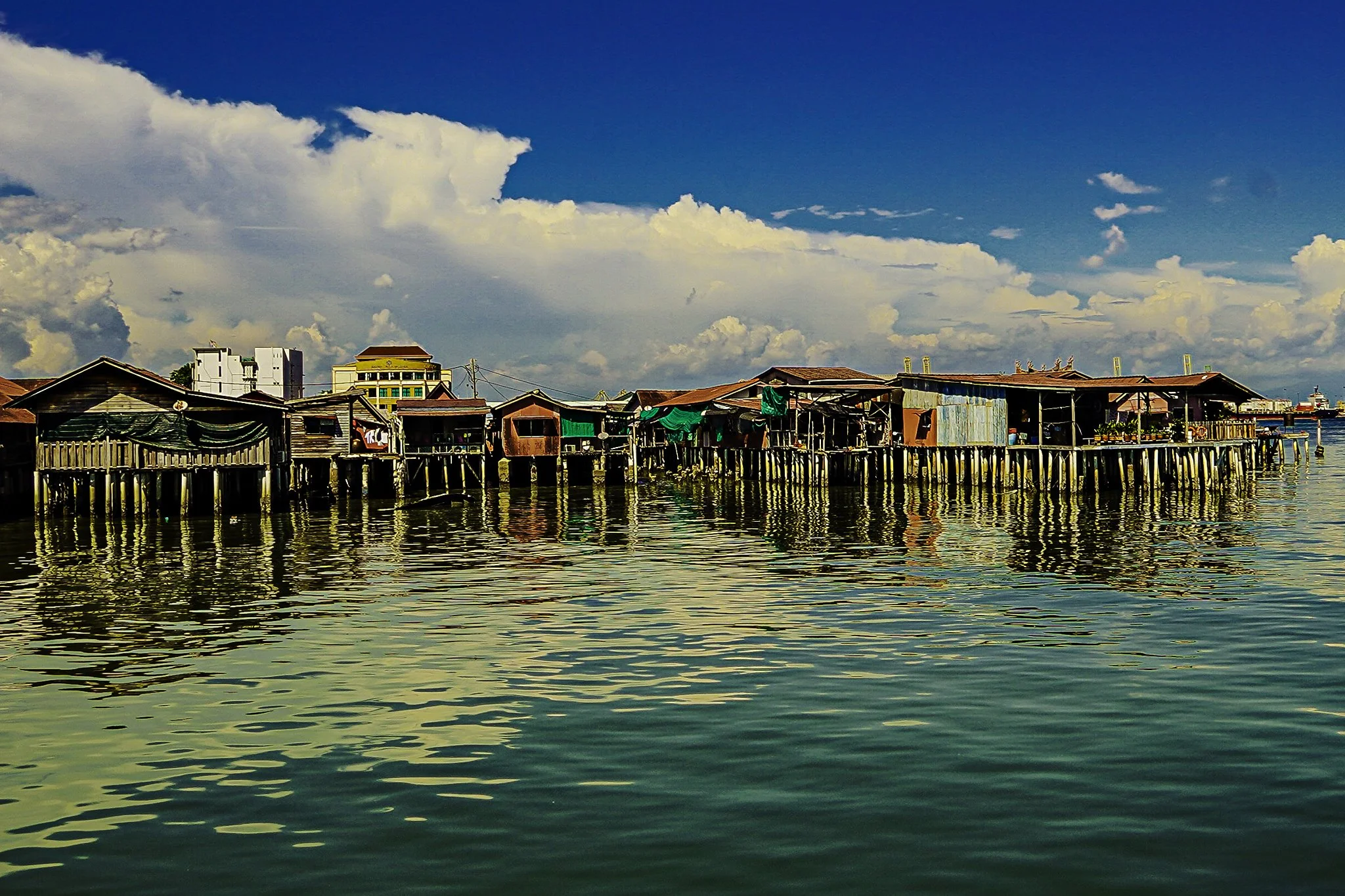
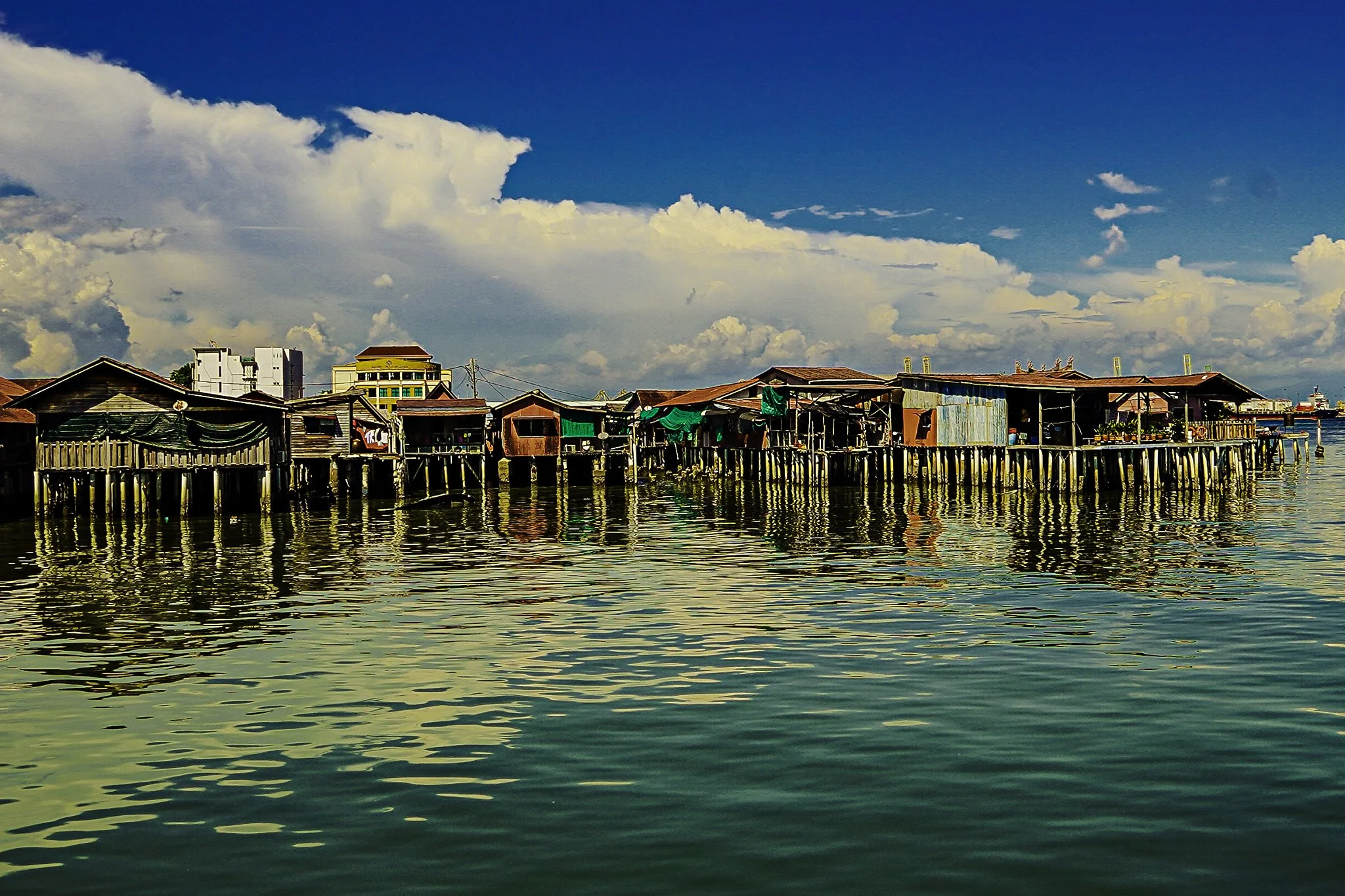
If the streets of Georgetown follow a grid of order, then the Clan Jetties of Penang represent its antithesis—a tangible form of Maritime defiance. In 1882, when British Architects executed the Weld Quay reclamation, intended to draw a hard line between the city and the sea, the Hokkiens used the ghauts—those colonial landing gaps—as the launchpad for their own timber expansion. This was the birth of a sovereign waterfront; using the saline-resistant hardwood, they engineered stilt houses and expansive piers over the mudflats. Initially designed as logistical hubs to anchor sampans and await the heavy tongkangs, these timber matrices quickly evolved into self-sustaining enclaves. By the early 20th century, the bloodline and trade amongst clansmen had interwoven completely, transforming transit points into permanent, communal territories united by mutual protection.
Yet survival here was an ongoing friction, as the jetties endured the fires of the World War II bombing, which temporarily reduced the Lim Jetties to ash, and navigated decades of demolition threats from authorities who misread the kinship as mere squalors. While some enclaves, such as Peng Aun and Koay jetties, were lost to the march of urbanization, the core clan communities refused to be dismantled.
Today, to walk the creating, salt-worn planks of the Chew or Tan Jetties is to walk through a living, breathing defiance. These are not static museums; they are bustling, analog ecosystems that actively withstand the surrounding concrete and the harsh rhythms of high tides and erratic weather, the descendants of those original merchants still expertly patch the hardwood against monsoon swells. As the temples pulse with incense over the lapping tide, the clans continue to maintain their territory—an unyielding, vibrant testament to a community that built its own ground when the world offered none.

The Analogue Metropolis
Lorem ipsum dolor sit amet, consectetur adipiscing elit, sed do eiusmod tempor incididunt ut labore et dolore magna aliqua. Habitasse platea dictumst quisque sagittis. Quisque id diam vel quam elementum pulvinar etiam non.
How 19th-Century Laneways of Melbourne Engineered a Subterranean Culture of Exclusivity.
To truly understand the internal rhythm of a hyper-modern metropolis, you have to look precisely where it chooses to hide its history. For most global cities, heritage is something preserved behind glass cases or isolated under museum spotlights—a stagnant memory safely separated from the rush of contemporary commerce. But in Melbourne, the past isn't a passive exhibit. It is a living, breathing subterranean infrastructure, woven directly into the dark, damp bluestone grids of 19th-century service lanes that stubbornly refuse to yield to the glass-and-steel sky expanding above them.
Walking off the wide, predictable concrete grid of the modern Central Business District, I always look for the exact seam where the digital defaults of the 21st century begin to fracture. It is a deliberate, sensory deceleration. The moment my feet transition onto the uneven, weathered bluestone bricks of a narrow alleyway, the ambient, sterile hum of traffic and glass skyscrapers is instantly swallowed by the cold masonry of a century ago. The air changes; it grows heavier, cooler, and dense with the sharp, grounding aroma of roasted espresso rising from unmapped basement stairs and hidden timber doorways.
This is where the metropolis hides its true luxury. It is an ecosystem built entirely on the privilege of exclusion and the beauty of analog friction. In an era where every modern experience is streamlined, flattened, and optimized for maximum speed, these shadowed, brick-lined channels demand that you slow down, navigate the geometry of the space, and pay attention to the details. True cultural capital here isn't broadcast on a flashing digital billboard; it is whispered through heavy iron fire escapes, low-lit archways, and the quiet, permanent confidence of an old-world architectural grid that simply refuses to be modernized.
Walking through the blue, cobblestone arches of Centre Place, sipping a warm mocha, I understood the architectural intent of the 1800s layout. It is a deliberate labyrinth. While Surveyor Robert Hoddle initially laid out Melbourne’s central civic grid in 1837 with the primary objective of a rigid, old-world order—sweeping thoroughfares designed to handle the heavy, industrial momentum of colonial commerce—embedded within this grand geometric design was a secondary network of narrow, deep-set service cuts. These lanes were never intended for public life. They were built as raw, functional vectors meant to isolate the noise, horse carts, and the grit of the city’s operational underbelly from the pristine main streets. Because their dimensions were tightly constrained by heavy masonry, these alleys were functionally useless to the automotive expansion of the mid-20th century. While other global metropolises leveled their historical cores to clear runways for multi-lane traffic, Melbourne’s lanes remained structurally locked in time, waiting for a cultural renaissance to invert their purpose completely.
The shift from neglected service corridors to urban luxury began when independent operators saw that invisibility could be monetized. Walking through the loud, flashing neon-lit CBD—especially Swanston Street and Chinatown precinct—true luxury behaves like a secret, where the laneway ecosystem thrives precisely because it rejects the modern default of easy visibility. The businesses that anchor these alleys—boutique fashion houses utilizing raw, unpolished industrial spaces, or world-class espresso bars operating out of literal holes in the masonry—do not court the casual passerby. They rely on the psychological allure of scarcity. By retreating into the shadows of the heritage architecture of Hosier Lane, these enclaves require their patrons to possess a deeper, more intimate knowledge of the city grid. The lack of standard street frontage transforms a simple transaction into an act of curation; I wasn’t merely buying a product. I was accessing an environment that had been deliberately filtered from the mainstream market.
Navigating this landscape from a personal perspective reveals just how profoundly the physical space alters human behaviour. As I watch the crowd from a low-lit timber bench in Degraves Street, the contrast between the world above and the world within becomes stark. Up on the main avenues of Bourke and Elizabeth Streets, the city moves as a relentless, hyper-optimized digital pace—a stream of commuters locked into the predictable, frictionless choreography of touchscreens and crosswalks. But down here, the bluestone demands a tactical awakening. The Uneven Cobblestone Pavement forces you to watch your step, slowing physical momentum down to an analog pace. The towering brick walls cut off the sky, trapping the deep, rich echoes of grinding coffee, low conversations, and the striking scent of the damp stone and polished wood. There is a magnificent, comforting weight to it. In these spaces, luxury isn't defined by a sterile corporate checklist or a slick modern aesthetic; it is felt through the heavy iron hinges of an unmarked cellar door, the dense texture of a century-old brick wall warming under a solitary Edison bulb, and the absolute certainty that you have stepped completely off the grid of commodity transit." This is the main body of the paragraph. And also I have mentioned a couple of places in Melbourne