Beyond The Straits
The Enduring Narrative of Penang’s Merchant Aristocracy
As the world gets busier and more modern, our tendency to rush around frantically and wear out our brains requires a deliberate withdrawal from the 21st century. While it is not possible to physically time-travel into the 90s (not as of now), it is possible to recreate an experience akin to the 90s in the quaint, post-colonial island of Penang, within its post-colonial capital, George Town.
Radiating a quiet, ancestral authority, the waved terracotta of the Cheah Kongsi stands as a sentinel over Lebuh Armenian.
As someone who has visited the post-colonial municipality twice, walking through George Town is to enter another dialogue with time—a conversation that modern cities have forgotten how to have. Here, the ‘straits eclectic’ architecture isn’t just a choice, it’s a defensive posture. It is a narrative of an aristocracy that didn’t just inhibit a landscape, but commanded it. Between the humid silence of the Hokkein timber-frame architecture of the Kongsis (clan houses) and the timber-weathered residential boardwalks of clan jetties lies a testament to a life lived by choice, not by compromise.
The historical weight of the Peranakan’s first legacies is no more palpable than in one of its clan houses, Seh Tek Tong Cheah Khongsi. Situated amidst the Straits Eclectic and Sino-Portuguese architecture of Lebuh Armenian (Armenian Street), one of the most-visited streets in George Town, The Seh Tek Tong truly stands out as one of the earliest Cheah clan establishments in Penang. Dating back to 1810, it upholds the diverse, yet historic Penangite amalgamation of British Colonial and Hokkien architectures that are indicated by the colorful terracotta swallowtail roofs and brick-walled red walls of the clan houses, combined with the British Architectural influence of double-storied bungalows and the presence of a balconied porch with wrought-iron railed fences. While the Cheah, from the village of Seh Tek Tong, has emerged as one of the first bastions of Hokkien trade, this has continued to evolve with the establishment of multiple clan houses. This architecture is the physical debris of a high-stakes migration. When the geopolitical shifts of the Ming Dynasty disrupted the ancestral farmlands of Fujian, the Hokkien elite didn't just flee; they recalibrated. They carried their culture across perilous straits, not as refugees, but as architects of a new trade reality. The swallowtail roofs aren't mere decoration; they are a stubborn geometry of defiance. In the collision of British Colonial bungalows and Hokkien timberwork, you see the exact moment an immigrant identity became an established aristocracy. The Cheahs were not alone in this architectural defiance; the remaining “Big Five” associations—Khoo, Yeoh, Lim, and Tan—mirrored its legacy, mapping out a new geography of influence in the straits.
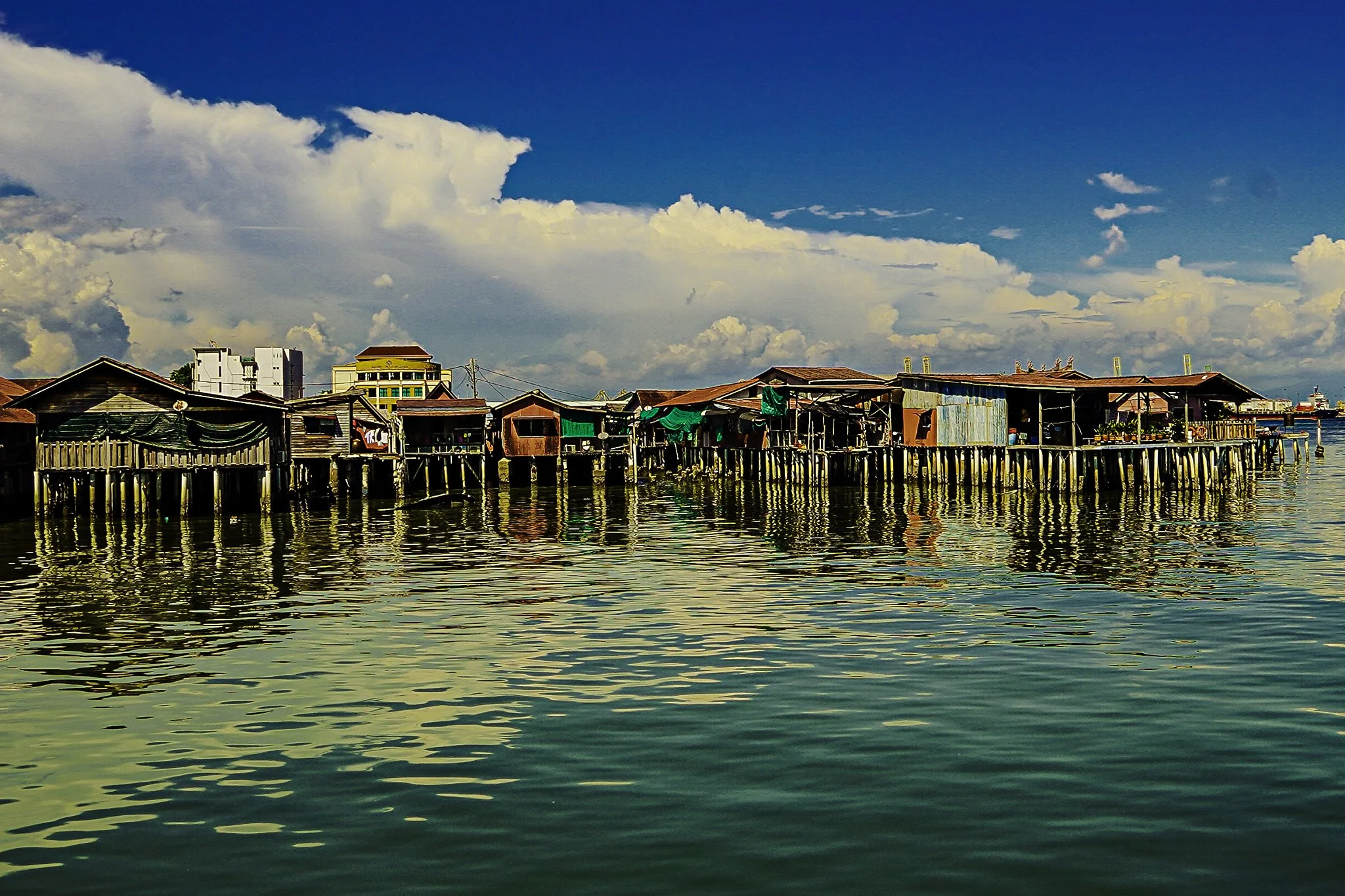
Penang’s saline-resistant timber lineup is a subdued, rugged testament to its maritime heritage.
As the gears shift beyond the Hokkien influence of the Kongsis towards European colonialism, the narrative of a merchant begins to expand into the vibrancy of Kaki Limas (five-foot ways) within the quaint streets of Georgetown. Founded by Capt. Francis Light established a bustling port in 1786, and the island became a strategic location for the East-West trade routes. With the island's freeport status, which attracted merchants and immigrants from European and Asian communities, such as Chinese, Indian, and Arab, the Sino-European influence is evident in Chinese Shophouses, with their high-arched, louvered (Venetians) and sea-green glass windows, Swallowtail Terracotta and Marseille roofs, and highly ornamented neoclassical arches. This is the sheer example of analog engineering that upholds the legacy of Straits’ eclectic architecture, navigating a deliberate dialogue through the evolving European Art Deco symmetry and the vibrant, humid energy of the Malay Peninsula. In this world, the grid was designed to contain the heat, but could never quite contain the soul of the city.
If the streets of Georgetown follow a grid of order, then the Clan Jetties of Penang represent its antithesis—a tangible form of Maritime defiance. In 1882, when British Architects executed the Weld Quay reclamation, intended to draw a hard line between the city and the sea, the Hokkiens used the ghauts—those colonial landing gaps—as the launchpad for their own timber expansion. This was the birth of a sovereign waterfront; using the saline-resistant hardwood, they engineered stilt houses and expansive piers over the mudflats. Initially designed as logistical hubs to anchor sampans and await the heavy tongkangs, these timber matrices quickly evolved into self-sustaining enclaves. By the early 20th century, the bloodline and trade amongst clansmen had interwoven completely, transforming transit points into permanent, communal territories united by mutual protection.
Yet survival here was an ongoing friction, as the jetties endured the fires of the World War II bombing, which temporarily reduced the Lim Jetties to ash, and navigated decades of demolition threats from authorities who misread the kinship as mere squalors. While some enclaves, such as Peng Aun and Koay jetties, were lost to the march of urbanization, the core clan communities refused to be dismantled.
Today, to walk the creating, salt-worn planks of the Chew or Tan Jetties is to walk through a living, breathing defiance. These are not static museums; they are bustling, analog ecosystems that actively withstand the surrounding concrete and the harsh rhythms of high tides and erratic weather, the descendants of those original merchants still expertly patch the hardwood against monsoon swells. As the temples pulse with incense over the lapping tide, the clans continue to maintain their territory—an unyielding, vibrant testament to a community that built its own ground when the world offered none.